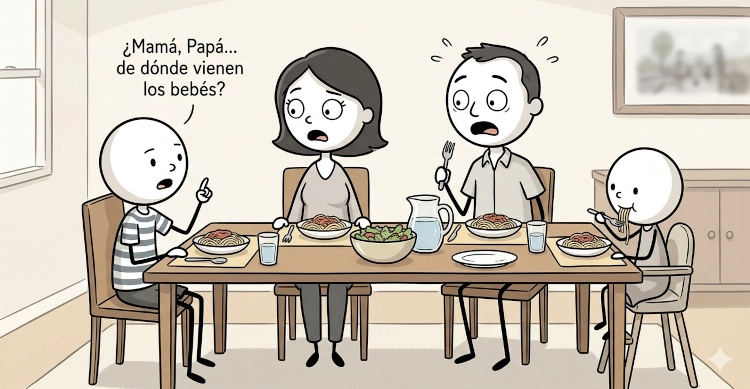
If you have preteens, you have probably wondered when to talk to them about certain delicate topics. In every home those topics may be different: the Three Wise Men, Santa Claus, the Tooth Fairy, where babies come from...
When is the right time to talk about these things? How long does it make sense to keep a little white lie alive to preserve the magic? And how much detail should we share?
The answer is not simple. In fact, even at home my wife and I often find it hard to agree 😅.
So I wanted to write this article, not to give anyone advice, but to share our experience and a reflection: not talking about certain things at the right time could also carry a risk, don't you think?
Note: Of course, the article has also been reviewed by my favorite editor, my wife 😜.
I think we often find it hard to talk about certain topics because, in a way, it means acknowledging that our children are growing up... and wow, they grow up so fast! 😭
But one thing is what we would like, and another is reality.
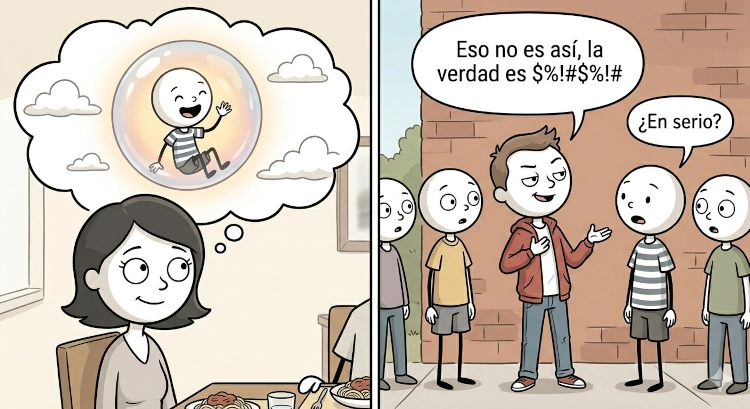
As much as we might want it, our children don't live in a bubble. In the end:
they spend a lot of time with their friends
with older children at school, after-school activities, siblings, cousins, etc.
they find things on the Internet, or another child does
and so on
That is why it is inevitable that, sooner or later, they will hear or see things. Sometimes those things reach them without them looking for them. Other times, they ask others or look for answers by themselves.
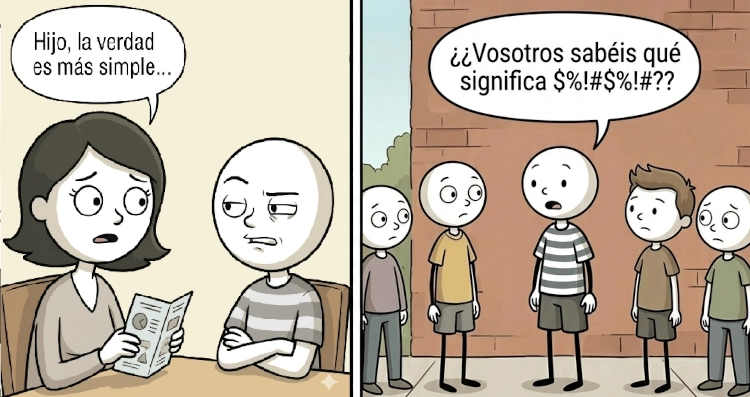
On the other hand, it is also normal for them to end up repeating things, often by imitation, and sometimes without really understanding what they mean.
In short, we often don't know exactly what they know or what they have understood, and that can lead us to misinterpret things 😕.
In any case, there is an undeniable truth that my son's tutor once told me:
Regardless of what we parents do or say,when one child "knows something", it is only a matter of time before the rest also "know it".
Because as soon as that topic comes up again, and one child sees that another child knows less, they may feel tempted to show off and "teach them a lesson", not only to prove that they know more, but also that they are "more grown up".
And whether we like it or not, let's accept it... it is inevitable. Hasn't it happened to us too? 😅
Our concern, as I imagine happens to many parents, is that postponing these conversations, telling "half-truths", or giving incomplete answers because we think they are still too young also has risks.
For example:
they may feel that they cannot talk to us about certain topics, and gradually lose trust and end up looking for answers elsewhere
they may receive or interpret information incorrectly and form mistaken ideas
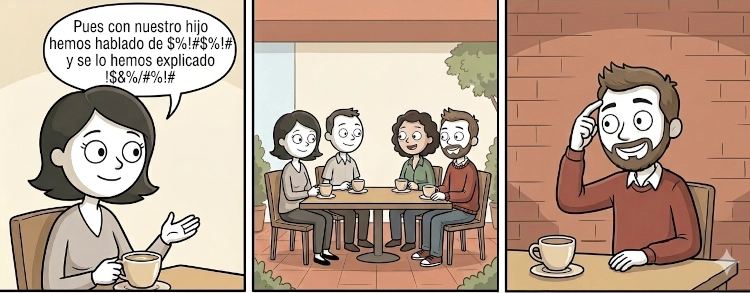
But there is something I think is even harder: talking about these topics with other parents, because sometimes they feel like "taboo" subjects.
I don't know if this happens to you too, but we find it difficult to bring up these topics with other families. Sometimes because of:
fear of making someone uncomfortable
fear of creating conflict
fear that, simply by mentioning it, someone might think something has happened
And this is not about all families having to think alike or explain things in the same way. Every home has its own timing, values, and way of explaining things.
But we do believe it helps to be able to talk about these topics more naturally with other parents, sharing what conversations are appearing in our homes and how we are approaching them.
Not so that we all agree on everything or impose one criterion, but so we have a bit more context.
If our children hear something from other children, we can explain why in our family we have approached the topic differently, without them feeling that we have hidden the truth from them or that we are treating them as if they were younger than their friends.
And if we are the ones who talk about something at home, it may also help other families to know that this conversation might come up.
It is better that they hear it from us, calmly and with context, than through an incomplete version told by children. Because that is where the telephone game effect can easily appear: one child tells something halfway, another interprets it as best they can, a confusing version reaches home, and we parents end up worrying or misinterpreting what happened.
Talking about it among adults should be about paving the way and being a little more prepared if the conversation comes up.
And we often wonder: are there more parents in this same situation, wanting to talk about it but not daring to take the first step?
Since they were little, we have repeated to them that:
adults are not taught how to be parents, and that, although we do the best we know and can, we also make mistakes
they are the most important thing in our lives, and almost everything we do is done thinking about helping them grow into good people and be happier
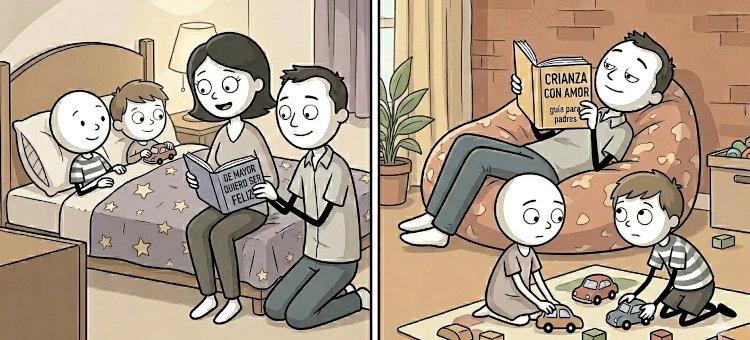
One example is the books we read with them, with the goal of giving them tools to understand themselves better and better understand the world. Some are more emotional books, such as 'De mayor quiero ser feliz' or 'El emocionario'; other times, they are books about the body, such as "Tu cuerpo es tuyo", financial education, or other topics. We also try to help them understand that behind those books there are important "life lessons".
In the same way, when we read parenting books such as 'The Whole-Brain Child' or 'No-Drama Discipline', we also tell them about it. We want them to see that we are still learning how to be parents and that, if they ever think we are wrong, they should tell us, because they may very well be right.
For example, I have had to explain to my eldest son once or twice that, although perhaps I would have told him some things earlier, it is not always that simple.
I want him to understand that I also need to agree with his mother and that, even then, there may be other people in the family, such as grandparents, who don't share our opinion, and we try to find a balance.
At home, since they were little, we have explained the concept of a 'white lie': those harmless or well-intentioned lies that are sometimes told with the other person's wellbeing in mind, for example, to make them feel good, to "protect" them, or to avoid hurting their feelings.
And we have already explained one of them to our eldest.
For more complicated topics, which need to be introduced little by little, such as "where babies come from", we do two things.
1) Try to help him become aware of how his tastes change
For example, we sometimes use comments he makes to his younger brother, such as when he says that a game his brother suggests is "for little kids", to remind him that, although he now likes other games, not so long ago he also liked that kind of game.
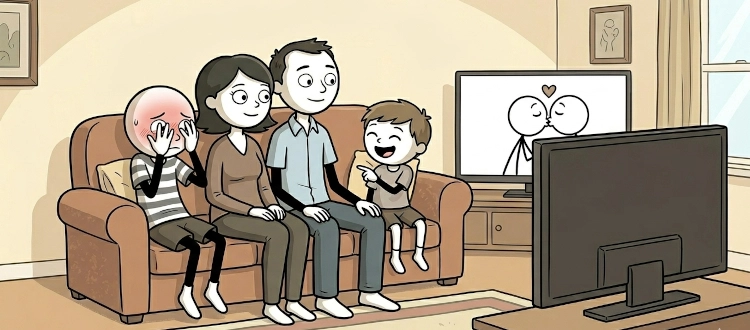
Similarly, there was a time when he felt uncomfortable seeing two adults kissing on TV. We used that moment to explain to him that it was normal, that sometimes there are things that make us uncomfortable at certain ages and that this can change later on.
2) Try to help him become aware of how his maturity level changes
We help him see that there are things you only understand when you are older, and to do that we try to find examples from situations he has already experienced.
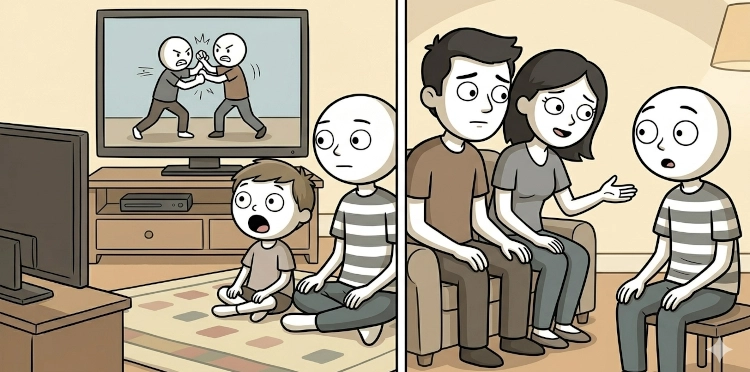
For example, we helped him see the impact it could have on his younger brother's behavior, vocabulary, etc., if he watched content or played games that our eldest liked, but that were not appropriate for his brother's age.
And we also helped him see that, even if we try to explain to his younger brother why he should not watch or play that, he is still not able to understand why it is not good for him.
And the same rule applies to both of them when it comes to content, games, etc. that we do not consider appropriate for certain ages at home: not because they are bad in themselves, but because they have not yet reached the maturity level needed to understand them properly.
Above all, what we always try to convey to them is that they can trust that we are doing what we believe is best for them, and that we want them to feel confident talking to us about any topic. Even if they notice that we are avoiding something, we would rather they insist and ask us why.
We try to make them feel that home is a safe space to talk, open up, and ask questions, and that when they do, we acknowledge and value it.
Although we hope all of this helps us maintain trust with our children, we still feel that an important piece of the puzzle is missing: being able to talk about these things with other parents.
In this article, I use “parents” to refer to both mothers and fathers, and “kids” to include both boys and girls. While I value inclusive language, I’m sharing our personal experience—my wife María and I are raising two sons—and we're comfortable with these terms to describe our family.
That said, everything I share here is intended for anyone raising, teaching, or caring for children, regardless of role, identity, or family structure.
I hope the language used doesn’t create a barrier for anyone.
⚠️ Content warning: this article contains a disturbing video and a minor spoiler from the miniseries Adolescence.
Fair warning: this is a long read—but parenting is a deep topic, and I wanted to explore it properly 😅.
Today I’ll explain how I use ChatGPT as support in trying to be a better dad.
And I say “as support,” not “as the main tool,” because I also lean on books, my wife, our families, people in our close circle, teachers, etc.
Example: You can see an example of this in the article Learn to Teach (at Home), which I wrote last year.
I’m sharing this after doing a bit of retrospection and reviewing all my ChatGPT conversations on this topic, hoping that my experience might be useful to you.
Just for context: I created my ChatGPT account in February 2023, and from that very first month, I’ve had questions about parenting.
I think most people would agree that when you have kids, your priorities shift—they become the most important thing in your life (spoiler... I’ll come back to this at the end).
I take it for granted that we all want to be good parents and do our best with what we know. But we also need to acknowledge that we make mistakes, like everyone. That said, there’s no need for self-flagellation—we also get a lot of things right, like reading articles like this to learn more 😜.
I really like something the author of the book "Guide for Imperfect Parents Who Understand Their Kids Are Imperfect Too" says (a gift from our sister-in-law a few Christmases ago): "Parenting is a beautiful opportunity to grow as a person, always remembering that we are NOT perfect, and our children don’t need to be either."
As if that weren’t enough, last week I finished watching the miniseries Adolescence, based on real events. It’s about a child who commits a crime and the guilt his parents feel, highlighting some of the modern-day challenges of parenting, especially those linked to technology.
Note: It dives into modern bullying, where social media plays a huge role. I’d argue most of today’s parents aren’t ready for this, because this wasn’t part of our own childhood. That’s why last year, Gabriel Zabal and I decided to organize a community talk for families on this topic. And we’re planning to do it again, because it’s essential to stay up to date.
Eddie Miller, played by Stephen Graham (the father in the show), breaking down in tears.
I admit I couldn’t hold back tears when the father says, "Forgive me, son. I should have done better." It’s impossible not to empathize with a devastated parent in that situation.
As I often tell my kids, we parents make mistakes too, but I also remind them that everyone has to take ownership of their part.
Because parenting is hard, right?
Just a few weeks ago, I told my eldest that there’s no school for parenting, that there’s no license you have to pass to become a parent.
Although, come to think of it... if you need a license to drive a car, maybe we should consider requiring something similar to raise a child—since, let’s face it, the responsibility is even greater 😅.
If you haven’t seen it and want a laugh, here’s the trailer for Idiocracy, a satire that takes things to the extreme (or maybe not so much?)—a future where intelligence has been replaced by collective stupidity 😂😂😂.
As parents, we constantly face doubts. Some are about our actions, others about what our children experience. Here are just a few of the questions that run through my head now and then. You might find them familiar:
About our actions:
Am I doing this right? Could I do it better?
Am I setting a good example?
Do I work too much? Do I spend enough time with them?
Did I overreact? How should I have responded?
Am I too impatient?
Am I too permissive? Or too strict?
Should I step in more? Or less?
Should I influence this? Or let them decide?
Am I being overprotective?
What am I doing wrong? Is this my fault?
How can I prevent them from going through what I did? Should I let them make their own mistakes?
About boundaries and autonomy:
Should I let them do this?
Should I give more freedom? Or less?
Do I let them do/watch this or not?
To what extent should I supervise? And how much trust should I place?
About what they go through:
Why are they doing this? Or why is this happening to them?
Are they doing it on purpose? Or unknowingly?
Why do they behave differently at home and at school?
How can I help them understand what happened?
About communication and values:
How do I talk about this without making things worse?
How do I explain it in a way they understand?
How do I instill certain values?
How do I achieve this without forcing, threatening, pressuring, or guilt-tripping them?
About development:
Is it too early to explain this?
How do I help them when they’re stuck? Do I let them try on their own?
How do I introduce this new routine or habit?
How do I handle their frustrations?
About motivation:
Should I encourage them to explore this? Or am I projecting my own interests?
Is it better to observe and support only if they show interest?
etc.
Sometimes we follow advice (whether we asked for it or not). Other times, we default to how we were raised, or we consciously choose a different path because times have changed or because we believe it's for the best.
But no matter what we do, it’s hard to shake the guilt when we feel we’ve done something wrong.
And that’s exactly why I’ll explain next how I’ve used ChatGPT to help navigate these parenting challenges.
But before that, let’s talk about something I think we shouldn’t overlook when using tools like ChatGPT in parenting: our children’s privacy.
Even if we use tools like ChatGPT in private and personal ways, that doesn’t eliminate the risks. In fact, by discussing our kids there, we could be engaging in a form of private digital sharenting—with consequences we don’t always consider.
Consider this:
Everything we share with ChatGPT is stored on their servers (in the U.S., under U.S. law).
Accounts can be hacked, or the servers themselves could suffer a data breach.
And I doubt you’d want that kind of sensitive information falling into the wrong hands—or ending up exposed online.
So my recommendation is to avoid sharing anything sensitive or easily traceable back to your child.
That said, I’ve spoken to both my wife and my eldest son about this. I not only asked for their consent to publish this article, but I also plan to continue doing so whenever I want to discuss personal topics using ChatGPT (or any other tool), as long as I believe the benefit outweighs the risk.
If this topic interests you, I’ve added more details in the Privacy Annex.
First, I used the free version for the first year, and since May 2024 I’ve subscribed to ChatGPT Plus (€23/month), which among other features, allows you to create Custom GPTs.
Types of attachment (secure, anxious, avoidant...)
Skills to reinforce at home based on developmental stage (household skills, time management, financial education, critical thinking, problem-solving, open culture...)
How to talk about the body, emotions, and relationships (what to say and how, depending on age)
To reflect on my parenting style:
Am I being too strict in some areas?
Are my reactions over the top?
To better understand certain behaviors or situations:
Why is it so hard for them to get up in the morning?
Why don’t they listen when I talk (e.g., if they’re watching TV)?
Why do they ignore me sometimes?
Why do they tell obvious little lies from such a young age?
Why do some fears appear (e.g., fear of someone breaking in, seeing themselves in a mirror at night...)?
Where does shyness come from, and how to work on it?
To adapt content to their age:
Rephrasing complex questions I don’t know how to explain well (e.g., the value of money: comparing $ vs € vs £)
Helping explain abstract concepts: terms (e.g., metaphor), differences (e.g., selfish vs greedy), medical conditions (e.g., epilepsy)
Explaining totally new topics (electricity, electronics, finance...)
Finding or creating stories/fables with a specific moral
Explaining Spanish sayings in kid-friendly ways
To find ideas, strategies, and tools:
Resolving conflicts (e.g., anger, jealousy, frustration from losing, from the younger sibling always being attended to first, etc.)
Finding new ways to introduce routines when the current one doesn’t work
Introducing or maintaining good habits (e.g., meditation)
Explaining how to do certain tasks well (e.g., highlighting or summarizing)
Coming up with ideas to make a school subject more appealing
Offering different ways to explain difficult concepts (e.g., reading analog clocks)
Tackling co-living challenges like when one child wants something just because the other one has it
Studying a subject (e.g., creating practice exercises—supervised)
Improving fine motor skills (e.g., creating dot-to-dot drawings)
To foster attitudes and skills:
Encouraging critical thinking from a young age
Sparking curiosity
Helping them become more assertive
Boosting self-confidence, autonomy, and love of self-learning
To explore science as a family in a fun and accessible way:
Ideas for robotics, 3D printing, and electronics projects
DIY experiments (like homemade bubble soap, etc.)
And yes, I know I could search for many of these things on Google too 😜—and I do.
That said, I’ve also occasionally used Perplexity, a handy tool for quickly getting up to speed on unfamiliar topics (e.g., I once used it to gather info about the game Fortnite before making a decision).
The benefits I get from it can mostly be summed up as:
It helps me answer my kids’ questions in ways I might not come up with on the spot1.
It makes me reflect, like I’m chatting (confidentially) with a stranger about the topic.
It gives me information I can cross-check with a professional (teacher, psychologist, etc.).
It helps me brainstorm.
It gives me new vocabulary to explore on my own.
It provides context on different topics.
(1) I always tell my kids: (1) you shouldn’t blindly trust ChatGPT, (2) you should only ask about topics you understand at least a little, and (3) it’s not a tool for them to use on their own just yet. But I do use it in front of them, read the answers out loud, and clarify when needed, so they can begin to grasp its biases and current limitations.
At home, ChatGPT doesn’t make the parenting decisions—we do, as a family.
Lastly, before wrapping up, I wanted to share a custom GPT I created in February this year, called Parenting Mentor, AI Expert. It’s designed to offer families a tool to help deal with some of the parenting challenges I’ve mentioned.
More specifically, it’s meant to guide moms and dads in problem-solving by analyzing root causes and exploring possible solutions.
💬 Note: it’s not intended for assigning it a task, but rather for having a dialogue.
⚠️ Reminder: for serious issues, always consult professionals.
As adults, it’s our responsibility to protect and weigh the risks vs benefits, especially when it comes to children under 14 (though my wife believes teens may need even more supervision and guidance).
Kids are more vulnerable in the digital world. We must act with extra caution, especially when using technologies like AI.
With tools like ChatGPT, it’s easy to share personal, emotional, or sensitive details without considering future consequences.
Even when using private accounts, the risk is never zero. Digital traces last, and what seems harmless today could be problematic tomorrow.
Even if a platform seems secure, no system is foolproof. Our accounts could be hacked—and we ourselves are often the weakest link.
We should avoid exposing our kids to real (or potential) harm:
Don’t share their full name, photos, voice, or any other identifiable data.
Avoid describing scenes that might be embarrassing, intimate, or sensitive.
We have to think long-term: What if this comes out when they’re older?
We must teach our kids the value of privacy and how to handle their own data. Involve them once they’re old enough.
If they’re mature enough, we should ask their opinion: check if they’re okay with us sharing certain info about them—even if it’s just to ask an AI for advice.
We should only share when the goal is to protect, educate, or address a real need.
And throughout all of this, we must remember: the best interest of the child always comes first.
So if you’re thinking of using any tool for parenting, my advice is: do it cautiously.
Despite everything, I believe that today, as parents, we have more resources and information than ever before to raise our kids well—books, videos, games, studies, AI tools like ChatGPT, and many others.
At the same time, we live in an era where things change at lightning speed, and while that brings opportunities, it also brings risks.
Let’s use what we have to stay informed, improve as parents, and reduce those risks.
Times have changed. It’s easy to fall behind and miss what might be affecting our kids.
As I said earlier, it’s true that from the moment they’re born, our children become the most important thing in our lives.
But remember: just like they tell you on a plane to put on your oxygen mask first before helping others, in life, we also need to take care of ourselves in order to care for them.
We need to be well—physically and mentally—because if we’re not, we can’t be good parents.
That means:
Don’t confuse "they’re the most important" with "they must be the top priority at all times."
If you mess up, if you stumble, get back up and keep going. Don’t beat yourself up with guilt: we all make mistakes.
They also need to understand that just like them, we need self-love and self-care to be present for others.
And even so, we’ll keep making mistakes. As someone close told me not long ago: “Raúl, no matter what you do, when they grow up, they’ll always have something to blame you for.”
And honestly? I believe it. I did the same with my own parents 😓.
That said, I won’t worry too much about the future. I’ll focus on enjoying the present—because that’s all we really have, and doing my best (with all my flaws and limitations). I’ll try, as much as I can, to keep learning and improving.
For now, I’ll continue exploring how AI can help my kids (and others) grow and thrive. I’ll keep sharing updates with other families through the AI and Education Podcast and in events at my kids’ school.
And I also want to:
Publish an article I’ve been working on—co-created with my son’s teacher and ChatGPT—on dealing with “little white lies” in early childhood.
Finish a "plan" I’m creating with the help of AI to use at home:
To understand and remind ourselves what skills and knowledge to focus on at each stage of parenting, based on our kids’ maturity level.
To know what we can do to put those ideas into practice.
To reflect on how to instill values and attitudes throughout the process.
If anything I’ve shared here resonated with you, I’d love to hear from you. Have you considered using AI in parenting? What questions or insights have come up for you? Feel free to reach out or share in the comments.
Let’s start with sharenting—something increasingly common in today’s society. Even if done with the best intentions, many parents don’t realize what it really means (and it’s not our fault if no one taught us about it).
A picture is worth a thousand words, so I’ll share a video on this topic—a tough watch, but important:
It’s a powerful reminder that we parents have a duty to protect our children’s image and privacy—especially when they don’t yet have the cognitive tools to understand the consequences of data sharing or how to defend themselves against more complex threats.
María and I have always tried to be very cautious about what personal info is shared about our kids online (on social media, etc.), and we’ve decided to deny consent by default for third parties to share their image.
It’s our responsibility to protect children’s right to privacy and image.
Depending on their age:
For children under 14:
We must protect their personal data, prevent its use without permission, and be cautious when sharing.
Give or deny consent on their behalf (though I think it’s best to talk it through with them and get their opinion).
Ensure we share only on platforms where we can request deletion of their data.
Avoid any form of profiling or influence.
For children 14 and older:
Help them understand the consequences of what they share and with whom.
Remind them they can delete their data or ask not to be tracked.
Teach them to recognize when their attention or data is being exploited.
Respect their space and privacy.
In any case, it is forbidden to share content that exposes, ridicules, embarrasses, or puts a child at risk—because that could lead to bullying, anxiety, or other negative effects down the line.
For much of my life, I’ve avoided sharing my opinions in public on controversial topics. Not because I don’t have any (I do, sometimes contradictory, politically incorrect, or evolving), but because I’ve been afraid of being misunderstood, judged, disliked, or disappointing people.
I’ve always felt uncomfortable with conflict. I’ve never liked picking sides or arguing about who’s right. I think I’ve tried to get along with everyone, often avoiding confrontation.
Maybe that’s why I’ve stayed quiet at times when sharing my thoughts could have brought value (even if it was uncomfortable).
While reflecting on this, I remembered something my dad used to tell me when I was a kid:
"Raúl, you should have friends even in hell." 👹🔥
It’s actually a pretty good piece of advice, though maybe I took it a bit too seriously. Or just misunderstood it 🤷.
Not long ago, I had a conversation with Francesc Puigvert that made me realize I’ve never really experienced the kind of “healthy rivalry” many people feel around football/soccer (since I’m not into it 😅). I’m not used to choosing sides. I shy away from confrontation.
Thinking it through, I came to a tough realization:
Silencing my opinions isn’t just a disservice to myself, it’s also, in part, cowardice. And more importantly, it’s not the example I want to set for my kids.
So this time, I’m going to be braver and share one of my “controversial” opinions (respectfully):
I believe in equality between men and women, and I believe feminism has been, and continues to be, necessary. But I also think that some aspects of modern feminism have strayed from the original goal of equality.
This is hard for me to say publicly, because I feel it’s one of those “politically incorrect” views that some might misinterpret as sexism.
Whenever I’ve shared this opinion with close friends, the response is almost always the same:
"Raúl, you’re not a beer 🍺. You can’t please everyone." 😂
I am who I am because of my experiences (just like everyone else). But I’ve learned that it’s important to express my ideas and opinions (with respect).
Fortunately, I don’t consider myself someone with fixed dogmas. What I believe today might shift tomorrow. I enjoy hearing solid arguments. I enjoy learning from people who see things differently. And when I share an opinion, it’s not because I think I hold the ultimate truth, but because I want others to understand me better, so we can understand each other better.
I’m also writing this because I want to lead by example. I want my kids to learn the same lessons I try to teach them with words:
They should be assertive, and not be afraid to express what they think, feel, or need, clearly and respectfully, without attacking others and without letting anyone disrespect them.
They should listen to, respect, and tolerate people who think differently, even if they disagree.
Changing your mind isn’t a weakness; it’s a sign of maturity and intelligence.
You can have a deep friendship with someone who sees the world completely differently.
And I say this because I live it (and I’m sure you do too 😉).
Many of the people I’m closest to hold opinions that are completely different from mine (on politics, religion, etc.), but that doesn’t stop us from loving each other.
Because a true friend is someone who really knows you, loves you for who you are (including your quirks), and even if they don’t always agree with you, they respect you, care about you, and are there when you need them.
That’s why I’ve decided to be more open, even in public. So people can get to know me better. And with a bit of luck, this will help me build more meaningful friendships.
Yes, some of my ideas might sound strange, naive, politically incorrect, or even uncomfortable. But all I want is to talk about them openly and respectfully, not to convince anyone, just so people can understand me a little better.
Mental note 🧠: If someone can’t appreciate me because we think differently... maybe it’s just not worth wasting time on, right? 🤷
If we want a better society, we need to show up as we are, listen more, judge less, and be more tolerant. If we only surround ourselves with people who think like us, we’re headed toward a more polarized and divided world. And that helps no one.
I’m still reflecting on my thoughts and ideas, and I hope to keep writing and sharing them here soon.
And if I ever say or do something you don’t agree with or don’t understand, I genuinely invite you to tell me (with kindness 😉). Really. Over a beer if needed... or a soft drink. I’ve come to accept not everyone likes 🍺 😜.
What about you? Is there an opinion you’ve kept to yourself for fear of not fitting in?
How do you deal with it? I hope I’m not the only one 😅.